Kodak, Adobe, recent magazine questions for IPEX

I think IPEX has started because I realise how slowly some things move. A year or two is not a great margin of error in thinking about the timescale for print developments. For example in Digital Printer May 2013 Nessan Cleary writes about hybrid printing and how the Prosper technology is being used alongside litho. I remember the Prosper from the 2010 IPEX so had thought that newspapers would be using it by now. There ​could be a regional Guide in the Saturday Guardian for Bristol and west. Just my concern maybe but apparently the consumables are still expensive. Can't find the full story online but there is also a blog.

PC Pro online has only got a guide to the Real World computing section.​ But the printed one in July ( available now ) has two takes on Adobe and Creative Cloud. Tom Arah reckons HTML5 is getting better and that new Edge products will take over from Dreamweaver. but more worrying possibly for Adobe is a decision from Kevin Partner in the online business section. He has a couple of months left on a Creative Cloud sub but is trying out the Serif to see if he can avoid the ongoing costs of Adobe declaring the end of perpetuity. He suggests that some people won't want the constant upgrades to the latest thing. It will be interesting to see how this works out over the year as Creative Cloud becomes the only option. Adobe will probably not be at IPEX but they look to be booked for BETT, also at ExCel next year So I can use my new set in Cloud Party as one location for conversation.. Also continues in text of course.
Cloud Party Monumental Art / IPEX 2014 has started

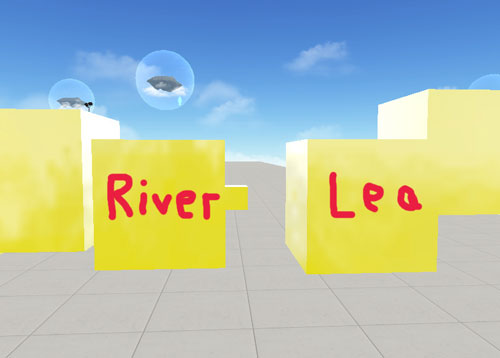
I have been accepted for the project so now have a studio. What I'm working on is not much like my proposal though. I seem to trade off issues in reality with imagined virtual spaces. So the idea of a video / radio linking studio was interesting when experiencing some limits. However I have missed a week of actual broadcast so now it seems ok to prepare for the Wild Show on a Thursday ( tomorrow  I will cover the storytelling at 9 also). I think that Cloud Party might not be ready for mixing sound and video. This could come later. The expectation is for "monumental" structure as art.

Meanwhile I have been trying to think about Exeter as a small scale space you can walk across. I also think about IPEX 2014, a print show at ExCel in London. You should be able to walk from the Olympic site along the River Lea but I think it is difficult towards the end. Best advice so far seems to be to head for Limehouse then ask again. A walk from King's Cross along canal and river would be enough to consider cross media and what IPEX is about. Via Islington later this year.​

So I have made a start on a sort of map that can be walked around. Not sure if the studio is open to the public. I don't know how to add text / labels . The stills are the current focus as they can be linked to other sites. Four attached to this post.

Next couple of posts, actual issues for IPEX. I may find that Cloud Party closes up time so I find it easier in one place. May last for the summer.​

riverLeaa.jpg
riverThames.jpg
excel-ed.jpg
xlleat.jpg

Studio in Cloud Party, radio maybe later

I have been offered a studio in Cloud Party for a few weeks. The aim is to develop public art. I think this could move on from Twinity. Cloud Party works in a browser, there is no need for a download. However I don't think you can have a screen or radio with a feed from another website. Maybe this will come later. This is still an early stage for Cloud Party. Once you have several video clips or bits of sound then a virtual studio ought to help to link it all together. You can either record something or let the public make their own choices. There is a phone in Cloud Party that takes stills. I don't think there is video yet.

Photos are from my studio and also sculpture at pixellada.com

pixellada.jpg
studioisland.jpg

Robots and Guardian concerns, can there be an education alternative?

As I think more about radio I must try to avoid being too provocative in how I present things. So let us avoid words like "panic". Teachers do have a concern about technology. I think the background is the change in their role that learner centred design implies.​

They obviously do have a point about the national curriculum and the danger of an agreed national set of facts dictated to every class. This is where today's worry about robots starts from.  But it soon becomes clear that the tablet or wifi device is only seen as a threat. the only agenda discussed is apparently coming from technology companies.

Will the Guardian find some space for the possibility that technology could support other forms of teaching and learning? Probably not, based on what they say about the MOOC situation. Trouble is that most people have access to a device as post compulsory education starts up at about four o'clock.​

Some sort of discussion needs to continue. I think the Guardian should find some space for where ICT fits in and what digital literacy is. Would it include video?​

MOOC, what is the innovation?

There is sunshine in between the showers here in Lancashire, so study of the olds mooc continues slowly. Through email I have found a recent set of papers, available for free download

http://www.elearningpapers.eu/en/paper/moocs-and-beyond

One I have started on helps to explain what a mooc is about-​

The disruptive innovation of MOOCs is in shifting costs from students to institutions and future employers, by offering services such as matching students to jobs using the evidence of their performance in MOOC courses.Many MOOCs are not sustainable in their current form, as they rely on venture capital and foundation funding which will either demand a return on investment or a sustainability model that does not require ongoing capital support. It is likely that different business models will emerge for MOOCs in the future, and the opportunities and threads posed to established institutions are as yet unknown but potentially significant.

MOOCs and disruptive innovation: Implications for higher education Li Yuan and Stephen Powell

I had been wondering about previous use of technology. There is a longer history than just the use of the term 'mooc'.​ I think there could be more on the mooc as promotion for paid courses, content marketing as others online call it.

Previous words include telematics, computer assisted learning, networked learning, probably several others I will check out later. The mooc is different because there is speculative resource trying out where it could go.​

I am trying to find out more about theories of disruption. This extends the issues around learning design. The OLDS mooc course had not much about organisation and resources. The UK universities associated with Futurelearn are still investing in buildings as far as I know. ​